Wednesday, March 18, 2009

i've got something for your face!


As my writing instructor at AFI used to say, "Yearning equals earning." What he meant by that was if you show characters who are obsessed, who have deeply felt yearnings for someone or something (their plot goal) then you have a movie with great potential for earnings.
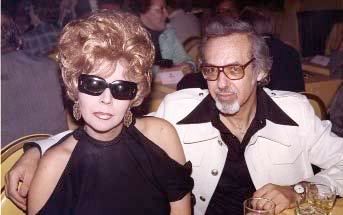
This week we took a look at the documentary Crazy Love for the purpose of studying character. It has all the classic details of a conventional narrative film (somebody wants something very badly; Burt's desire for Linda. It's almost impossible for him to get it; she's engaged to someone else, he's married- plus it gets worse when he hires thugs to throw acid in her face. In the end he gets what he wants; Burt and Linda have been married since the mid-seventies.) What sets this film apart though are the characters. Burt and Linda are unlike any conventional characters we know, and as such they're unforgettable. Normally I'd talk about the tricks the writer used to create these characters but in this case they are their own creation. Nevertheless we can break them down into specific traits that can be applied to your characters.

Burt:
  • An underdog with a tragic past who makes the most of his present
  • Driven by a passion that exceeds logic and reason
  • Admits when he makes mistakes, breaks the rules
  • Aware of his crazy actions and unable to stop himself
  • Has initiative and ingenuity
  • Is charming when he gets what he wants
  • Is a real threat when denied what he needs

Linda:
  • An underdog with a tragic past who makes the most of her present
  • Aware of her talents and abilities but does not abuse them (her youth, beauty and charm)
  • Takes adventure when it is offered, not one to shy away from life
  • Takes the moral high ground when confronted with betrayal
  • Lives life in defiance of her attacker as best she can
  • Finds overwhelming compassion and forgiveness for the unforgivable
  • Cutting insight and sense of humor
If you set out to write a fictional story about a man who throws acid in the face of his ex-girlfriend only to end up marrying her fifteen years later you might struggle with the plausibility issue. A documentary obviously does not have this problem. In fiction we have to believe in the characters first and foremost. Everything else hangs from that. I feel you can solve any plausibility problem in terms of plot so long as you've done the work of making your characters real. That doesn't just mean a well drawn character will work in any situation. Your characters have to be perfect for that situation.

When I start out to write a new script I begin by asking myself, why does this character have to go on this journey? From that question comes a set of character traits and flaws that they will explore and repair over the course of the story.

For our class I had my students watch the film then write a 1 to 3 page scene based on Burt and Linda. It could present any moment before, during or after the story in the film. The results were uniformly terrific. The reason, in my opinion, is that when you really know who your characters are your writing becomes more life like and dynamic. I encourage writers when struggling with a character's identity to try a couple of tricks. First go through your address book and see if there's anyone from real life you can base this character on. If not, go through IMDB and look at characters and actors. Sometimes having an actor in mind makes it easier to write. Either way, having that solid foundation in reality will make the process of writing for your characters easier and hopefully yeild a better script.

I'm going to a Film Independent seminar tonight; ten tricks for getting great performances from actors. I should have my notes posted tonight or tomorrow.

Next week we'll be taking a look at unsympathetic main characters in our analysis of The Honeymoon Killers.

Friday, March 13, 2009

insider information


This week we took a look at the film Inside Man in an effort to understand the mechanics of a thriller. I always talk about these films as if you've just finished watching them, so if it's been a while you may want to check it out before reading this post. The first thing we did was take a look at the scene breakdown. As with every film I assign, I like to have a list of all the scenes that we can refer back to. It's a good habit to get into if you're trying to deconstruct a film and it certainly helps to understand structure.
We noticed that almost every scene in the film deals with the A story: the heist. The B story (Detective Miller's troubles at work with the missing $140K) and the C story (his girlfriend and the pending marriage proposal) account for about 2% of the movie and they are usually handled within the context of the A story. That's something to keep in mind about thrillers-- there tends to be room for just the A story and not a lot of tangential information.
Raymond Chandler said, "When things slow down, bring in a man with a gun." Good advice. Scenes of quiet introspection are followed by quickly paced scenes that raise the stakes and generally involve a degree of life-and-death risk. It keeps the reader/viewer on edge and the juxtaposition of quiet with noisy can create an interesting effect.
Often writers will make things too easy for the protagonist in the early draft. I always say get them up a tree and start throwing rocks at them. Whatever you can think of that will make it as hopeless, as impossible and bleak as you can imagine is probably the right way to go. Never give your protagonist a convenient break. Making this work is a matter of setups and payoffs. In the film Detective Miller meets up with Ms. White (Jodi Foster) and you pretty much figure she's going to manipulate him into doing her bidding. She's got everyone, including the mayor, wrapped around her finger so preventing a low level detective from doing his job and exposing her client is not a big deal. However, she turns out to be key in Detective Miller's successful exposure of the larger crime (the Nazi diamonds) and ultimately is the reason he is cleared of any wrong doing in the missing $140K issue back at the station. Another way to do this is to give your protagonist a time limit and then if possible, shorten the time limit. Miller has a hostage situation and a ticking clock that lets us know how close or far he is from solving the case.
Just as important as making things hard for your protagonist is giving them enough initiative to see them through the story. They MUST solve this case. More depends on it than doing their job. It's all about something larger and more important than that. They have to heal some wound, protect their family or friends, in some way they must have skin in the game.
For sure, one of the worst mistakes you can make when writing a thriller is not doing the research into your protagonist's career. Most likely your protagonist is a detective. This does not necessarily mean they work for the police or an agency, though. They may be a Miss Marples type-- someone with no official license or training. But you have to know the details of investigation in order to make your story feel real. In Inside Man one of the details that gives this film it's texture is the careful portrayal of racism in the post 9/11 NYPD. Then there's the standard stuff; teaching us new information about hostage negotiation and the technology that makes it possible.
One of my favorite things about this film is the way it continues even after it ends. We had a bit of a debate in class about whether Detective Miller keeps the diamond at the end or not. The class was pretty evenly split. The open-endedness of this question mirrors the larger themes in the film and does not lend itself to easy answers. The writer sets up a very interesting moral dillema and lets us see all the arguments for each side then leaves us to make up our own minds about what is right and wrong. The recent film Doubt does the same thing.
You may be hearing a lot lately about how the studios are only interested in genre films (comedy, horror, thriller). There is some truth to that, genre films are easier to market and because the studios are beholden to corporate parent companies they're under ever greater creative constraints. You might be tempted to write a genre film for a quick buck. This is a mistake. First off, the notion of a quick buck is a complete fallacy. I've never seen anyone make a quick buck as a writer. If you spend a year or longer of intense work on a script it MIGHT result in a sale. That's a big if. The second thing is you have to LOVE what you write or it won't work. I've read many thrillers that weren't thrilling, horror scripts that weren't horrific and comedies that weren't even remotely comedic. The only script you should write is for the movie you are dying to see. You have to go into your story with enthusiasm because it is the only thing that will sustain you when you are on draft twenty three in year two of the writing and you've yet to see a single dime. In short, the only way I know to succeed is to write for love and not for money.
Next week we'll be discussing character based on a viewing of the documentary "Crazy Love."

Sunday, March 8, 2009

book report

My current students know that after two years of resisting Blake Snyder's "Save the Cat" I finally broke down and bought a copy. Well worth it. Particularly for chapters four and five. My resistance to the book stemmed from the fact that I found it somewhat... there's really no other way to say this, vulgar. It breaks screenwriting down into a method that felt a bit mechanistic and formulaic in my opinion. However, if you're having trouble with structure, frankly there's no better way to go than mechanistic and formulaic.
Unlike the 70 beat outline you're familiar with, Snyder breaks structure down into 40 scenes with 15 specific sections. It's a unique approach that results in a shorter first act and a longer 3rd act than the method I've been teaching. I used his methodology to develop a pitch for my most recent writing assignment and found it incredibly helpful. Still waiting to find out if I got the job.
In these budget conscious times it's even available at the public library. Remember those?

Friday, March 6, 2009

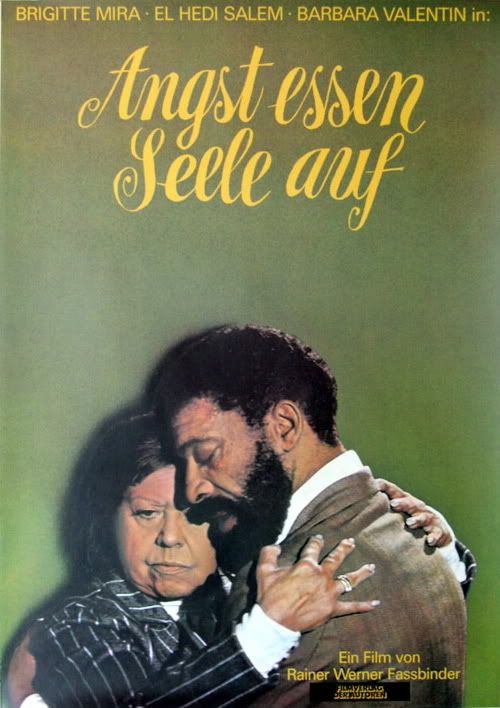
ali: fear eats the soul


So this week we watched the Fassbinder masterpiece: Ali: Fear Eats the Soul. The misleading title sounds kind of like a horror film but it's not. I failed completely to catch the connection between Fear Eats the Soul and Harold & Maude. They'd make a good double feature: Age transgression films of the 1970's.
The reason I assign this film is because it's so simple in terms of plot yet complex in terms of emotions. This is the kind of film where the story is the big special effect. It explores the taboo relationship between an older German Putzfrau (cleaning lady) and a Moroccan Gastarbeiter (guest worker). The details of their relationship are covered in honest and emotional detail. There's nothing exploitational going on here and the sincerity of their feelings for each other hooks the viewer in and keeps you hanging on to see how things will turn out.
I've heard a theory recently that we go to movies to worry. We sit there in the audience asking, "will they be able to stay together despite everything that's happening to them?" Each plot point in the movie deepens that worry. They defend themselves against external racism in the first half and then come to terms with their internalized cultural clashes in the second half.
In the beginning of the story Fassbinder uses examples of rascism both overt and understated to make his point. Some people in their orbit give them the evil eye so to speak. My favorite is the waiter at "Hitler's favorite restaurant" who stares through them with a gaze that could mean anything but almost certainly means disgust. Of course the most shocking moment comes when Emmi's family meet her new husband, Ali for the first time and they FREAK OUT. Her son even goes so far as to kick in her television. It's awesome. The lesson here is that you've got to let your characters freak out from time to time. It's a huge moment and an emotional release for the audience.
The second half, as I mentioned, deals with the internal enemy to their relationship. When it was Ali and Emmi against the world they were united. Once the people near them begin to accept that Ali's not going anywhere Emmi and Ali grow apart. Why? They have the acceptance they originally sought. Well they're not done growing. See your characters need to have 2 fights in every movie. The first fight is against the outside world. Whatever villain they're chasing or antagonist they're dealing with represents the external fight. The second fight is a bit harder to describe. It's psychological. The way I like to pin it down when I'm outlining a new story is I ask myself, "Why does this character have to go on this journey?" There's some part of the journey that will heal the damage done by life, society, or themselves. For Emmi she needs to let Ali be the man he is instead of trying to turn him into a respectable German. If you think about the movies you love and ask yourself, "why did the main character need to go on this journey" you'll come up with the answer. A good exercise is to outline those films and highlight the specific scenes that deal with that internal fight.
Fassbinder's one of my favorite filmmakers because I love watching Germans be mean to other Germans. Schadenfreude, Weltschmertz und natürlich Verfremdungseffekt.

Friday, February 27, 2009

geriatric therapy


This week we watched Harold and Maude the Hal Ashby film from Colin Higgins screenplay. It's one of the most perfect comedies in my opinion. Usually a comedy this old does not really hold up, you know? Like how everyone talks about how hilarious The Apartment is but when you watch it it's kind of depressing with zero laughs. I mean it's amusing, but come on, straining spaghetti with a tennis racket is not super hilarious. No disrespect to the genius Billy Wilder- it's just that over time what we thought was funny becomes less funny. It's the march of culture. Anyhow, back to Harold and Maude. Here are ten lessons I learned from watching the film this week:
  • Do it with style. Harold is a one of a kind character. Sure he’s a weirdo, but he does it with such panache- we can’t help but admire his resourcefulness. A fake hanging, that crazy wrist cutting- buying a hearse. Where have you ever seen this guy before?
  • Bring into the life of your Protagonist the unlikely instructor. They learn lessons from their opposite- from the person they’d like to be or the person they fear the most. Harold is someone obsessed with death even though he's so young. Maude is near death and yet in love with life.
  • Make a decision about the moment your character falls in love and show it. When does Harold fall in love with Maude? We’ve had lots of reasons why they’re a good match, but what is it that makes him fall for her? In my opinion it's the oderifics moment in her train car. If you look at his face as she "plays" the smell of snow falling on 45th street for him you can see him falling in love. It's further illustrated when he has him reach into her sculpture which is basically a giant wooden vagina.
  • State your philosophy and illustrate it. At the 38:00 minute mark Maude says, “I feel that much of the world’s sorrow comes from people who are this (indicating a single daisy), and yet allow themselves to be treated as that." (indicating a field of daisies)
  • What your main character wants and what your main character needs can be opposite of each other. Harold wants to die (attention from his mom) and yet he needs to live (independence from his mother’s world).
  • Actions speak louder than words. At the 60:00 minute mark we get more about Harold from what he does than what he says. This is the moment where his mom brings over yet another prospective "date" for Harold. As the date is talking about her job Harold proceeds to fake cutting off his hand in front of her. He has not a line of dialog and yet he has said so much.
  • Your hero’s unhealthy talents should be used in a new way; in the service of good. In the scene where Harold meets with his uncle in advance of being shipped off to the Army he and Maude stage an elaborate "murder" to paint Harold as a liability and unsuitable for enlisting. Here everything he's good at comes to play to quite literally save his life.
  • Your antagonist (Harold's mom) is all the more formidable when they have the institutions of society on their side. Your hero isn’t just battling their situation, they’re righting a larger wrong. Harold's mom is at the pinnacle of society. She's rich and proper and everything you're supposed to want to be- and yet, we'd rather be with Harold.
  • Take us to unexpected places. But it’s all the better when we go there willingly. By the time Harold and Maude consummate their relationship we're on board. It's a bit of a shock but we're kind of okay with the fact that a 20-something and a 70-something just had sex.
  • Pain and the scars of life define us… and your characters. Often your main character is on the verge of drowning in life’s grief. This is their struggle for liberation and in some cases maturity. This moment will define them for the rest of their days- choose wisely. No trivial moments will do. This essentially represents the point in Harold's life where if change does not happen he will die. It's true. If Maude had not come into his life it's a pretty good bet that in ten years or so he would have killed himself for real.

summer writing program


So for the past two summers I've been teaching at the Squaw Valley Community of Writers near Lake Tahoe. They offer a screenwriting workshop that is an intensive week-long program focusing on craft. It's pretty much designed for writers who have a draft of a script that they want to perfect. I'm a big fan of programs like this one or the Film Independent Screenwriting Lab because unlike the Sundance Lab, you can actually get into them without knowing someone. They're not as well known, but they offer the same level of instruction and support.
The Squaw Valley program was created over forty years ago by a group of writers including the head of AFI's screenwriting department, Tom Rickman. It's basically like a summer camp for writers. The deadline for applications is Saturday April 25th. The cost of the program is $750.00.

Friday, February 20, 2009

i'll be back


This week our movie was The Terminator. While we can all agree it's no masterpiece there's a good bit to be learned from the film. Particularly taking notice of how James Cameron handles secondary characters and the revelation of exposition.

Secondary Characters
The film is populated by secondary characters who are pretty memorable. This is no accident and serves to make them stand out on the screen, but also on the page. When reading a script you've probably run into a character on page 60 and had to ask yourself, "who is this again?" If you give them a big characteristic, even if it's just one note, we'll always remember who they are and not be confused by a reappearance after vanishing for twenty pages or so. There are many examples but Sarah's roomate is a good one. We call her walkman-girl because she is never seen without her walkman (pictured above sharing an intimate moment with her boyfriend and a Tones on Tail cassingle.)

The other thing about these secondary characters is that they serve to reinforce the theme of the movie. It's all about a world gone mad. Most of the secondary characters are in support of that idea. The Terminator could steal clothes from anyone when he arrives nude at Griffith Observatory in act 1. But instead, he steals them from a group of new-waver punks. The aformentioned walkman girl with her giant 80's hair and narcisistic need for constant musical entertainment. The freaky overall wearing hillbilly in the phone booth (remember those?) Even the soon-to-be-dead detectives chain smoke with nihilistic abandon.

Exposition
Exposition largely occurs during moments of intense action. It's a great way to get a lot of information across without it suddenly turning into My Diner With Andre. Sarah Conner is brought up to speed about time travel, terminators, the coming machine revolution and her role as the rebellion leader all while fleeing the Terminator. It's a ten minute car chase sequence that by itself might be boring. It occurs so early in the movie we know our heros will get away. So what to do? Combine the obligitory action sequence with the obligitory exposition sequence and suddenly you have something that grips your attention. It's always a good idea to have your scenes do double duty, but this one works particularly well. It happens right at the start of act two (around the 36 minute mark) and is worth checking out. Action combined with exposition works in more than just this particular genre. In a romantic comedy you could combine the first date exposition with a comedy set piece to achieve the same effect.

Next week we'll examine the voice of the writer with Harold & Maude.